BRISK ATLAS / GUIDES
Supplier evaluation criteria: what to score and what to gate
Supplier evaluation criteria fall into two groups: must-haves that a supplier meets or does not (certificates, capacity, insurance, contract terms) and weighted criteria where more is better (quality, cost, delivery, service). Sort every criterion into one group before you weight anything, because a must-have scored on a 1–5 scale can be outvoted by the rest.
Common criteria and where they belong
| Criterion | Pass/fail when… | Weighted when… | Evidence |
|---|---|---|---|
| Quality | A certificate or an approved sample is required | Comparing yield, audit findings or sample results | Certificates, sample reports, audit notes |
| Cost | There is a hard budget ceiling | Comparing total evaluated cost (price, tooling, freight, duty) | Quotes normalised to the same scope and currency |
| Capacity | The required volume is fixed | Spare capacity for growth is a bonus | Capacity statement, site visit |
| Delivery and lead time | A launch date cannot move | Faster or more reliable is better | Quoted lead time, trial orders, references |
| Compliance and insurance | Almost always | Rarely | Certificates of insurance, code of conduct, licences |
| Contract and IP terms | A clause is non-negotiable | Comparing payment terms or warranty length | Redlined contract |
| Financial stability | A minimum credit rating is policy | Comparing risk among acceptable suppliers | Credit report, accounts |
| Service and communication | Rarely | Almost always | Response times during the RFQ, references |
| Engineering support | Rarely | The part needs design changes | Design-for-manufacture feedback |
| Sustainability | A customer or law requires a certification | Comparing reported performance | Certificates, disclosures |
The test for each row: would a high score on everything else make up for failing this? If the answer is no, it is a must-have. Mark it Pass, Fail or Unknown, and keep it out of the weights.
What happens when a must-have is scored instead
Take the freight forwarder example, where a cargo insurance certificate is a must-have. With the certificate as a gate, Meridian Freight wins and Tidal Cargo, which has not supplied one, waits in Needs review. Now turn insurance into a criterion weighted 5%, with the other weights shrunk in proportion: the two insured forwarders score 5 on it and the missing certificate scores 1.
| Forwarder | Insurance as a must-have | Insurance scored at 5% |
|---|---|---|
| Tidal Cargo | 4.25 · Needs review | 4.09 · rank 1 |
| Meridian Freight | 3.85 · Eligible | 3.91 · rank 2 |
| Pacific Bridge Logistics | 3.60 · Eligible | 3.67 · rank 3 |
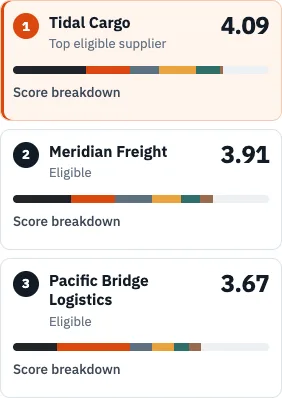
The uninsured forwarder now ranks first, because its strong transit, claims and customs scores outweigh one bad score. In this example insurance has to carry about 9.1% of the total weight, close to the 10% customs support has, before Tidal Cargo stops winning, and that threshold would move with every change in the other scores. A gate needs no such tuning: no certificate, no award.
Small weights do little
On a 1–5 scale, the most a criterion with weight w can move a total is (5 − 1) × w ÷ 100. A criterion at 3% can change a supplier’s score by at most 0.12 points; one at 25% by up to 1.00. If a criterion is not worth at least a few percent, it is cheaper to record it as a note than to score it for every supplier.
Selection criteria vs. performance criteria
The criteria above are for choosing a new supplier, where the evidence is quotes, samples and audits. Once a supplier is in use, score measured results instead — delivery, defects, invoice errors — as in the supplier scorecard metrics guide.
Questions
Should price be a must-have?
Only as a hard ceiling (“no more than $X per unit”). Otherwise score total evaluated cost as a weighted criterion, so a slightly dearer supplier with much better quality can still win.
How should the criteria be weighted?
There is no standard set. Agree the weights before the quotes are opened, then check how sensitive the winner is to them; the examples show weights and breakpoints for three decisions.
More guides
- Supplier scorecard template (Excel, CSV and printable)Excel workbook with formulas, a blank CSV and a printable PDF.
- Supplier scorecard examples: three filled-in samplesPackaging, contract manufacturing and freight, scored and explained.
- Supplier scorecard metrics: formulas and 1–5 scoringOTIF, defect PPM, responsiveness, invoicing and price, with formulas.
- Weighted scoring model: formula, example and ExcelThe formula, a project selection example and the Excel version.
- Vendor scorecard: running a quarterly vendor reviewA worked quarterly review of three current vendors.